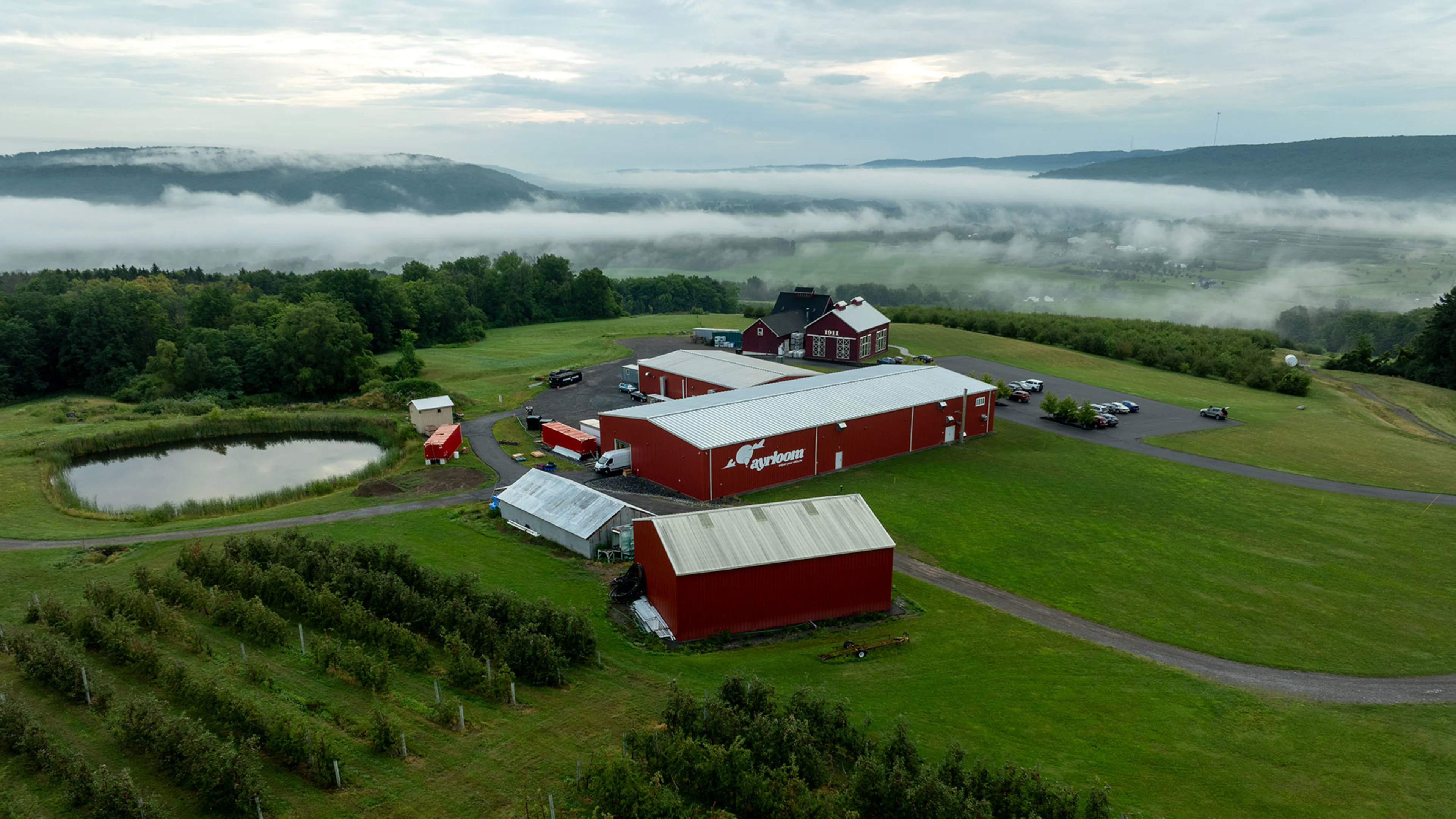
Nestled in a fog-hewn upstate New York valley just a few miles beyond Syracuse, Beak & Skiff Apple Orchards, a family-owned orchard, has been a staple of the region since 1911, when farmers George Skiff and Andrew Beak decided to go into the apple business together. It's the kind of idyllic place that families plan yearly fall trips around, both to take home bushels of fresh apples and take in the orchard's epic scale, which at 1,000 acres is over 16 percent bigger than Manhattan's Central Park.
But in March of 2012, Beak & Skiff looked anything but idyllic. Along rows of trees, employees had set hundreds of smudge pots and piles of hay to burn, as the orchard's owners scrambled to keep their crops warm. That month, temperatures had spiked from freezing to around 80 degrees, tricking the trees into believing it was summer. "All the trees woke up, and then the temperature went back down. Everything froze," says Pete Fleckenstein, a fifth-generation family-owner who oversees the growth and harvesting of Beak & Skiff's more than 350,000 apple trees. For the first time since 1945, the apple orchard had no apples.
Insurance gave Beak & Skiff a temporary reprieve, but it was clear to Fleckenstein and the aging fourth-generation family-owners that the business was at a turning point, and bold new leadership would be needed to save the farm.
That new leadership came in the unexpected form of Fleckenstein's city-dwelling cousin Eddie Brennan, who visited every summer as a child, but was less enthused about waking up at 4 a.m. to move irrigation pipes. "It wasn't what I wanted to do," he says.
For Eddie, whose mother grew up near the farm, the orchard was a far cry from the high-powered corporate world inhabited by his father's side of the family. Eddie's paternal grandfather, Edward A. Brennan, served as the chairman and CEO of Sears (Eddie fondly recalls visiting his office in the Sears Tower), and his father, Edward J. Brennan (known as Big Ed), was named CEO of travel retail giant Duty Free Shoppers in 1999.
Eddie decided to follow in the footsteps of the men he was named after and go into retail. After graduating from college in 2005, Eddie got a job in New York City as an assistant buyer for Bloomingdale's and began working his way up the corporate ladder. In 2010, he married Marianne Kixmiller, a high school acquaintance and director for now-defunct Nordstrom subsidiary HauteLook.
In 2012, not long after frost had wiped away nearly all of Beak & Skiff's apples, Eddie and Marianne got news from his father, Big Ed; he was retiring and looking into buying an ownership stake in Beak & Skiff, bringing his decades of leadership experience to help save the farm.
"I contacted him," admits Fleckenstein. "I knew he was retiring and the partners here were getting along in age. I didn't see a way forward for the next generation without some outside help." Big Ed, who had already been planning a move to the Syracuse region after retiring, saw an opportunity to open up new revenue streams by diversifying Beak & Skiff's offerings. Prior to Big Ed's friendly takeover, the orchard made more than 80 percent of its yearly revenue from the six-week apple picking season in the fall, but Big Ed believed the orchard's near-unlimited supply of apples could be used to create value-added products that could be sold year round, like hard cider and spirits.
In 2014, after buying out several fourth-generation family-owners and becoming Beak & Skiff's general manager, Big Ed called Eddie and Marianne with a proposition: He wanted to know if they would pack up their lives and move upstate to help him transform the struggling orchard into a scrappy startup. "I was seven months pregnant," says Marianne, "so the plan really got flipped on its head."
For Eddie, joining his father would mean taking a 100 percent pay cut, but the upside potential was too strong to ignore. "I always thought Beak & Skiff had this inherent value that wasn't always seen," he says. He'd seen how people who visited the orchard almost always left with a warm, authentic impression of the place, and Eddie felt the farm could do more to harness those good vibes. That September, with a 6-week-old daughter in tow, the 30-year-old parents left the city and started their new lives at Beak & Skiff.
Today, 10 years since the Brennans' big move, Beak & Skiff is more successful than it's ever been, because for the first time in the all-American orchard's 113-year history, its most popular product is no longer apples—it's cannabis.
Eddie arrived at Beak & Skiff for his first day in 2014 with no ambitions to become a leader in a then-illegal industry. But in short order, he'd not only become a leader, he'd help Beak & Skiff dominate New York State's rapidly growing legal weed industry. Indeed, in November of this year cannabis analytics platform Headset called Beak & Skiff's cannabis brand Ayrloom New York State's top provider of THC beverages, tinctures, topicals, and vape pens as it notched over $5 million in sales for the month. In less than two years since selling its first product, Ayrloom is now bringing in as much revenue as the rest of Beak & Skiff combined, Eddie says, and is poised to "outgrow Beak & Skiff pretty dramatically" going forward.
"Ayrloom is definitely the largest brand in sales in New York State," confirms Eddie. And it was all sort of a whim.
When he showed up at the farm 10 years ago, there was no training program or clear direction for what he should even do. "A lot of people were like, 'Why is he here? What's he going to add to the business?'" he says. Eager to prove that he knew how to work on a farm, he hopped on a forklift to help move pallets. He was driving past Fleckenstein when he hit a patch of mud.
"I flipped it, right in front of the entire farm crew," admits Eddie. "He tried to keep it quiet, but we had to pull it out," says Fleckenstein with a grin. "It was in a visible spot."
He may not have been cut out for farm work, but Eddie was undeterred. He and Marianne threw themselves into revitalizing 1911, Beak & Skiff's fledgling hard-cider business. The previous generation had spent nearly $1 million to build a state-of-the-art hard-cider facility, but didn't have the marketing experience to take the product to the next level. Eddie and Marianne transitioned from bottles to cans, started printing the family's story on their packaging, and hired cidermaker Yann Fay to create bold new offerings, like a cider donut-flavored hard cider. The rebrand came at just the right time to capitalize on the hard-cider resurgence of the 2010s, and within a few years, 1911 was responsible for driving nearly half of the orchard's total revenue.
The pair also pursued an old childhood dream of Eddie's: using Beak & Skiff's ample land to host outdoor summer concerts. The first series, held in 2016, was only moderately successful, but musical acts fell in love with the space, and booking agents started to take notice. Year by year, the concert series has continued to grow more popular and has booked more notable artists like Bleachers, Noah Kahan, and the Flaming Lips. This summer, Eddie says over 60,000 guests attended concerts at the orchard.
Those early successes proved that Eddie and Marianne weren't just city slickers, they were uniquely skilled at translating the orchard's authentic charm into new products and events. Big Ed noticed this, and let his son in on a secret: Duty Free Shoppers' board had asked him to return as CEO and chairman, replacing the executive who had replaced him. It was a call Big Ed couldn't refuse, but he felt confident that with just a few years of experience, Eddie was ready to take the reins at Beak & Skiff, and run the entire 1,000-acre operation. He was 33.
"I felt like it happened 10 years too early," recalls Eddie, but at that point he was so busy that he barely had time to reflect on his rapid ascent. By 2018, 1911 had grown into a massive success, and separately, several deals with East Coast grocery chains like Wegmans had turned Beak & Skiff into one of the region's top producers of cold-brew coffee. To handle all this new work, the farm's employee count ballooned from around 30 to 100.
In his first year as the top boss, Eddie and chief financial officer Mack Hueber identified their next big gamble: CBD beverages. The 2018 Farm Bill made it federally legal for farmers to grow hemp, a variety of cannabis containing barely any THC, and extract the non-psychoactive CBD chemical for use in a huge variety of products. The projected effects of CBD were vague enough that the chemical could conceivably be added to almost anything: drinks, balms, gummies, even dog treats. The CBD market was projected to generate billions.
On a whim, Eddie and Hueber applied to a state-sponsored hemp pilot program, in which participating farms got permits to be among the first in the state to produce CBD products. Beak & Skiff was accepted, and Eddie saw an opportunity to gain a first-mover advantage. He decided to go all in.
Several million dollars later, much of which came from a "significant" loan, Beak & Skiff had constructed a brand-new cannabis processing facility, and the farm planted nearly 50 acres of hemp, anticipating a boom in CBD products. But Eddie wasn't the only farm owner who saw CBD as the next cash crop; supply for CBD products badly outstripped demand, and by 2020, the craze was over before it had even begun. Between the pandemic and the missed bet on CBD, "there was a lot of pain in the New York farming community," says Eddie.
The one silver lining to the CBD saga, says beverage head Fay, was that "legal THC was definitely on the horizon in New York State," and once it arrived, they'd be ready.
In March 2021, nine years after the frost that changed the farm's trajectory, the moment Eddie had been waiting for finally came. Governor Andrew Cuomo fast-tracked legislation to legalize recreational adult-use cannabis, with the first dispensaries set to open in late 2022. The fifth-generation family-owners formed Gen V Labs, a sister company to Beak & Skiff entirely dedicated to the production of THC-infused products. Hueber, who transitioned from his CFO role to lead Gen V, set an ambitious goal: launch a new cannabis brand on the first day of legal sales in New York State.
Eddie and his team immediately got to work. They constructed additional space to produce and store THC beverages, concocted flavor formulas in labs, and onboarded more employees. As the new venture's head of marketing, Marianne wanted the family's cannabis brand to be approachable to consumers who might be trying cannabis for the first time, but also reference the family's storied history. She landed on the name Ayrloom in reference to heirloom apple varieties, which some apple-farming families pass down through generations. Working with local design firm Stay Fresh, she developed a retro midcentury modern style for Ayrloom, with bright pastel colors and unique cylindrical packaging.
The team's prep work paid off, and in August 2022 Ayrloom was granted one of New York's very first cannabis processing licenses, thanks to their prior involvement in the hemp program. Having finally obtained clearance to grow a single acre of THC-rich cannabis, and with only a few months before the first dispensaries opened, they hit the ground running.
On December 28, 2022, the first day of legal cannabis sales in New York, Ayrloom-branded vapes and edibles hit the market, and less than a month later, the company sold the state's first THC-infused beverage. Ayrloom's products immediately became bestsellers in the New York market, which Hueber attributes to their first-mover advantage, beginner-friendly branding, and robust sales operation, which has seen Ayrloom representatives visit nearly every New York dispensary to educate sales associates, also known as "budtenders," on their products. There are currently 269 recreational cannabis dispensaries in New York State, and Eddie says Ayrloom products are sold in more than 95 percent of them.
Ayrloom's vape pens, their most popular product, are designed to appeal to both newcomers and stoners. While some flavors are named after cannabis strains, like "Cereal Milk" and "Alaskan Thunder Fuck," others are designed to bring on certain effects, with names like "Focus" or "Rest." They've also expanded their offerings to include "beverage-enhancing" tinctures, which they're selling this year as part of a "Canna Cocktail" holiday gift set, complete with an Ayrloom-branded shaker and recipe card.
Ayrloom's best-selling beverage also happens to be Eddie's favorite: Honeycrisp. The orchard's own honeycrisp apples are pressed in the hard-cider facility and infused with cannabis. "It's the one product that ties all of our businesses together," says Eddie.
Nowadays, the Ayrloom and Beak & Skiff brands are fully intertwined. At this year's summer concert series, guests enjoyed hemp-infused Ayrloom "micro" drinks along with their hard ciders and bought Ayrloom sweatshirts and mugs from the gift shop. During the Flaming Lips concert, while holding up a giant balloon that said "Fuck Yeah Beak & Skiff," frontman Wayne Coyne told the crowd that the orchard might be the most beautiful place he'd ever performed at.
In an effort to avoid another CBD kerfuffle, New York regulations prevent farms from growing more than an acre of cannabis, but Ayrloom's products have been such huge sellers that at times, the company has needed to buy additional cannabis from neighboring farms to meet demand. In an effort to double the brand's storage and processing capabilities, Ayrloom is currently in the midst of building a new warehouse. The rapid growth is "exciting but really overwhelming," says Eddie.
When it all gets too overwhelming, Eddie hops in an ATV and drives up to the most elevated spot on the property, a hill with a single gigantic oak tree. From there, he can see nearly all of the family's 1,000 acres, a reminder of what they came so close to losing, and what he's been working so hard to preserve. His thoughts naturally turn to his grandpa Marshall Skiff, whose ashes were scattered there. "He always kept journals, and he wrote about some really devastating nights where the temperature dropped to 25 degrees and he lost the whole crop," says Eddie. "It must've been such a helpless experience, watching all your work deteriorate around you."
In 2023, Beak & Skiff experienced another bad frost and lost nearly half its apple crop for the year, and consistent rain in the fall took a bite out of their apple-picking season. But because of all the diversification efforts that Eddie and the entire family have made over the past decade, that frost wasn't nearly as devastating as the ones experienced by his grandfather in 2012. What could've been a death blow was just a bump in the road.
In his own way, Eddie is furthering the legacies of both of his grandfathers, the apple farmer and the Sears CEO, while establishing his own legacy for the family's sixth generation, including Eddie and Marianne's three daughters, to carry on. Eddie often wonders what his grandpa Skiff, who spent his entire life caring for Beak & Skiff, would think about the orchard today. "I think he'd understand that it's helping us preserve our thousand acres," says Eddie. "He would've been awesome at growing cannabis."
Read on Inc.com →